
iTero Element Scanner
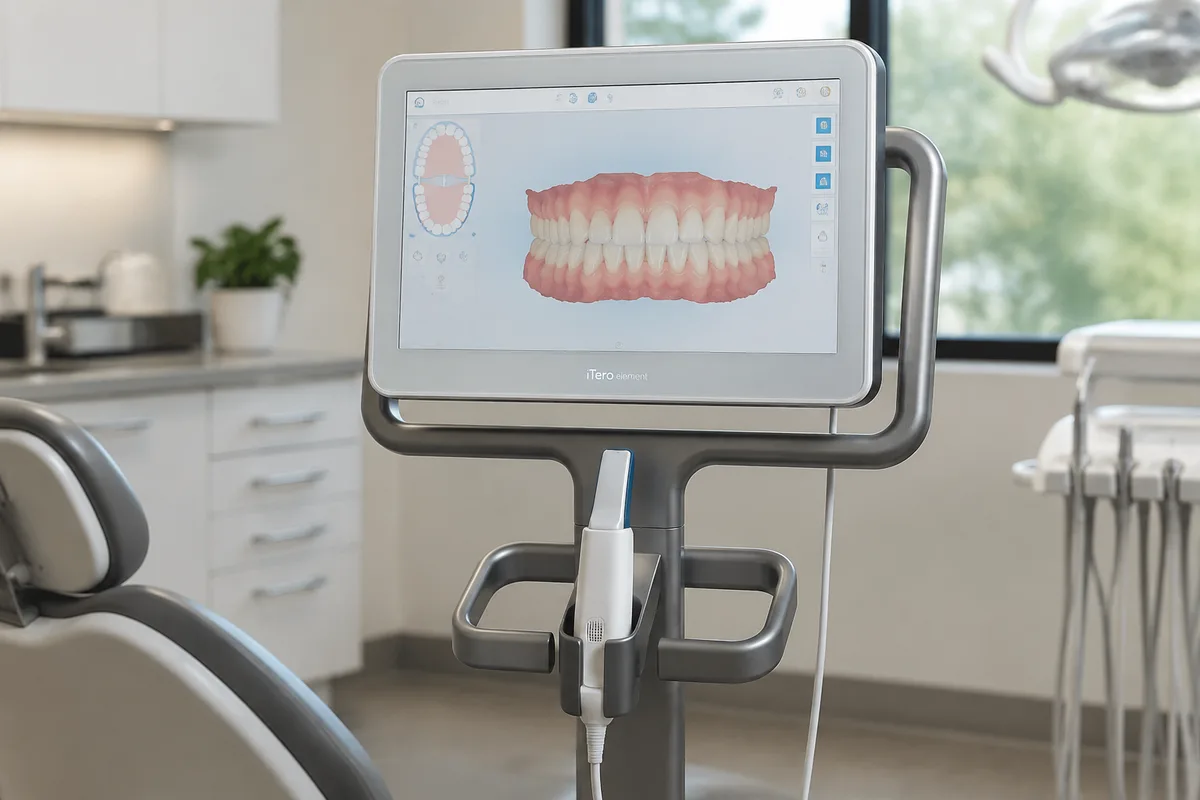
iTero Element Scanner
The iTero Element Scanner is a digital wand that captures a detailed 3D image of your teeth, gums, and bite in place of a traditional putty impression. At 1st Family Dental in Chicago, IL, we use it to create digital 3D impressions that are faster and more precise than the old method, and it also lets us show you a simulated preview of what your smile could look like after Invisalign treatment.
What iTero Element Scanner is
Before digital scanners, dentists relied on trays filled with a soft putty-like material that patients had to bite into and hold still for several minutes while it set. The material could taste unpleasant, trigger a gag reflex, and sometimes needed to be redone if it shifted or bubbled. The iTero Element Scanner replaces that process with a small handheld wand that is passed over the teeth and gums, capturing thousands of images per second and stitching them together into a live, rotatable 3D model on a screen.
Because the scan is digital from the start, it can be reviewed immediately, sent electronically to a lab or aligner manufacturer, and stored as part of a patient's digital chart. Nothing has to physically set, dry, or be mailed, which removes several of the steps that made traditional impressions slower and less predictable.
How we use it at 1st Family Dental
At our Chicago office, the iTero Element Scanner is most often used when a precise, comfortable digital impression is needed instead of a putty mold. This includes cases being planned for Invisalign clear aligners, where the scanner also generates a simulation of the projected tooth movement so patients can see a preview of their smile before treatment begins. It works alongside our other digital tools, including Digital Smile Simulation for cosmetic and orthodontic planning, and Fully Digital Records, which means your scan becomes part of a paperless chart that our team can access across visits.
Because the scan is a computer file rather than a physical mold, it can be reviewed on screen with you at chairside, making it easier to talk through orthodontic or cosmetic planning together. Where a case calls for additional imaging, such as evaluating bone or nerve structures for implant planning, that information comes from separate tools like our 3D Cone Beam CT Imaging or Panoramic X-Ray rather than the iTero scanner itself, which is focused on the visible surfaces of the teeth and gums.
What it means for you
For patients, the main difference is comfort and clarity. Digital scanning removes the need to bite into and hold a mouthful of impression material, which is especially helpful for anyone with a sensitive gag reflex or who has found traditional molds unpleasant in the past. The process also tends to move faster, since there is no setting time to wait through and no risk of having to redo a smudged or shifted impression.
Seeing your teeth on a screen in 3D can also make it easier to understand your own dental situation. Being able to look at the same model your dentist is looking at, and in Invisalign cases, to see a simulated preview of potential tooth movement, gives you a clearer picture to base treatment decisions on.
What to expect during your visit
If a digital scan is part of your visit, there is generally little to no special preparation beforehand. Your dentist or hygienist will guide the scanner wand around the outside, inside, and biting surfaces of your teeth in a series of smooth passes, building the 3D model on screen as they go. Most people find the process quick and straightforward, since the wand is compact and there is no tray or material in the mouth.
Once the scan is complete, you and your dentist can review the 3D image together on the monitor. If the scan is being used for Invisalign planning, this is also typically when a simulated preview of projected tooth movement is generated and discussed. The finished scan is saved digitally, so it can be referenced again later without needing to be retaken from scratch.
Frequently asked questions
Is the iTero Element Scanner safe?
Yes. The scanner uses light and digital imaging to capture the shape of your teeth and gums; it does not use radiation the way an X-ray does. It is a non-invasive tool that simply records the surfaces it passes over.
Is scanning uncomfortable?
Most patients find digital scanning more comfortable than a traditional putty impression, since there is no tray, no material to bite into, and nothing that needs to set in the mouth. The wand is guided around the teeth in a series of passes rather than held in place.
How long does a scan take?
A digital scan is generally quicker than a conventional impression because there is no waiting for material to set. The exact time can vary depending on how much of the mouth needs to be captured and the purpose of the scan.
Who is a digital scan suitable for?
Digital scanning can be used for most patients, including those being evaluated for Invisalign clear aligners or other cases where a precise digital model of the teeth and gums is helpful. Your dentist can tell you whether a digital scan or another imaging method is the right fit for your specific situation.
If you would like to learn more about the iTero Element Scanner or find out whether it is right for your treatment, reach out to 1st Family Dental to ask our team or schedule a visit.
This content is for general information only and isn't dental or medical advice. Talk with your dentist or orthodontist about your own situation. If you have a medical emergency, call 911.