
Temporary Anchorage Devices
Temporary Anchorage Devices
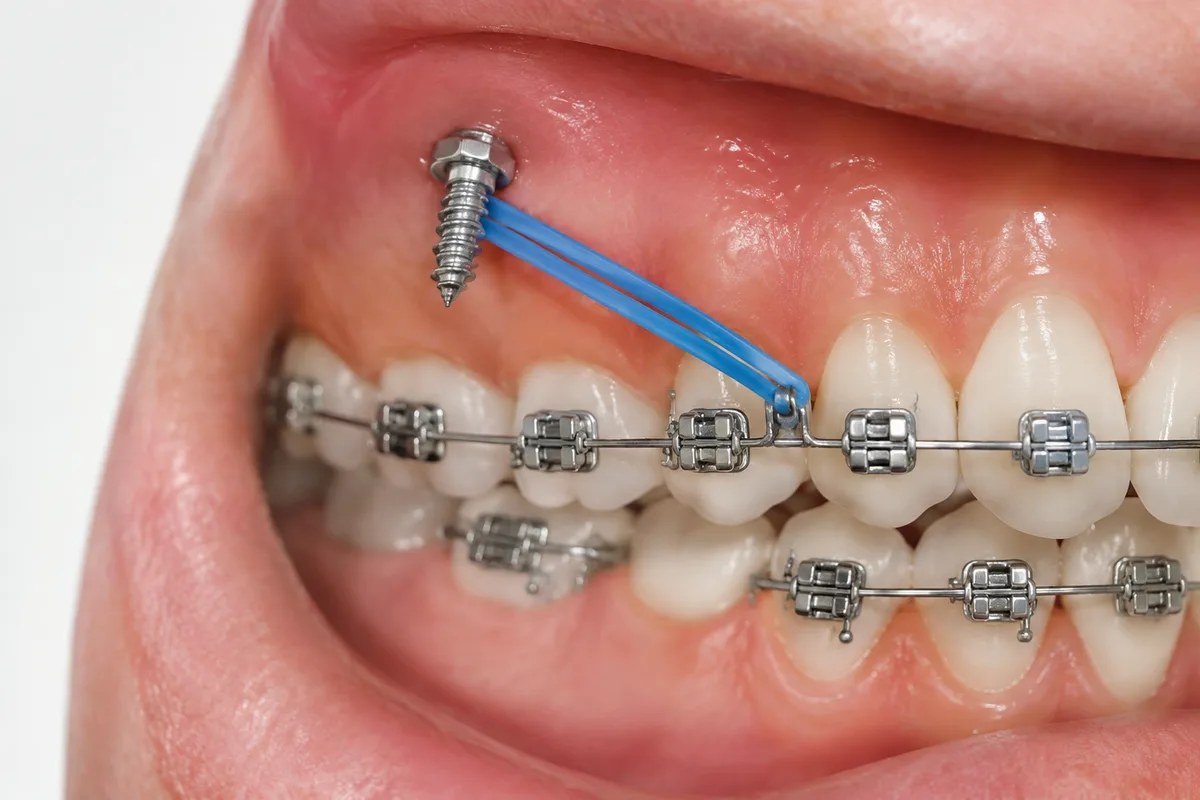
Temporary Anchorage Devices, often called TADs, are small titanium anchors that orthodontists use to move teeth more precisely in cases where traditional anchorage isn't enough. At 1st Family Dental in Chicago, IL, TADs are one of the tools our orthodontic team can call on when a treatment plan calls for extra control over how teeth shift.
What temporary Anchorage Devices is
A Temporary Anchorage Device is a small screw, usually made of titanium, that is placed just beneath the gum tissue and anchored into the jawbone. Because the TAD doesn't move, it gives the orthodontist a fixed point to pull or push against, similar to how a wall anchor holds a hook that would otherwise pull loose from drywall.
Before TADs became widely available, orthodontists relied on other teeth, headgear, or elastics worn between the upper and lower jaw to create the resistance needed to move a tooth or group of teeth. Those methods depend on patient cooperation and can shift teeth that were meant to stay in place. A TAD removes that dependency by providing anchorage that stays exactly where it's positioned for as long as it's needed, then is removed once treatment goals are met.
TADs are typically used for closing gaps, moving molars forward or backward, correcting bite issues, or intruding a tooth that has drifted out of alignment — movements that would otherwise require more complex appliances or a longer course of treatment.
How we use it at 1st Family Dental
As our facilities overview notes, TADs let our orthodontists move teeth more efficiently in complex cases. Dr. Sameer Al-Obaidi, one of our orthodontists, has training in temporary anchorage devices alongside conventional fixed appliances, clear aligner systems, and other orthodontic techniques, and is familiar with incorporating TADs into a broader treatment plan when a case calls for them.
Placement and monitoring of a TAD is planned using imaging already available on site. 3D Cone Beam CT Imaging and Panoramic X-Ray give a clear picture of bone density and root position, which helps identify a safe, effective spot for the anchor. Once placed, treatment can be tracked using digital records, and where clear aligners are part of the plan, the iTero Element Scanner helps monitor how teeth are responding. For patients pursuing shorter treatment timelines, TADs are sometimes discussed alongside our accelerated orthodontics options.
What it means for you
For patients, the main appeal of a TAD is precision without added bulk. Because the anchor does the work that headgear or extra elastics used to do, there's often less reliance on removable appliances and less room for treatment to be thrown off by a missed elastic or a headgear left in a drawer.
- Targeted movement — teeth move in the direction planned, with less chance of unwanted shifting elsewhere in the mouth.
- Less visible than headgear — the anchor sits quietly beneath the gum and isn't noticeable in day-to-day life.
- Removable when treatment is complete — a TAD is meant to be temporary and comes out once it's no longer needed.
- Works alongside braces or clear aligners — it's an added tool, not a replacement for the rest of the orthodontic plan.
What to expect during your visit
A visit to place a TAD generally starts with a review of your existing orthodontic records and imaging, so the orthodontist can confirm the best location for the anchor. The area is numbed with local anesthetic, and the anchor itself is placed in a short procedure, typically completed in a single office visit.
Most patients describe the sensation as similar to a routine dental injection, with mild pressure during placement. Afterward, some tenderness around the site is common for a day or two, similar to what you might feel after other minor dental procedures. Once in place, the TAD is connected to the orthodontic appliance — braces, an aligner attachment, or a spring — and does its work quietly in the background between regular orthodontic checkups. When treatment reaches the point where the anchor is no longer needed, it's removed in another brief visit.
Frequently asked questions
Is placing a Temporary Anchorage Device painful?
The site is numbed with local anesthetic before placement, so most patients feel pressure rather than pain during the procedure. Some mild soreness afterward is normal and typically fades within a day or two. Patients who feel anxious about the procedure can ask about sedation options, including nitrous oxide, which is available on site.
How long does a TAD stay in place?
A TAD stays in place for as long as it's needed to accomplish the specific tooth movement it was placed for, which varies by case and is determined by your orthodontist as part of your overall treatment plan. Once that movement is achieved, the anchor is removed in a short follow-up visit.
Who is a good candidate for a TAD?
TADs are generally considered for orthodontic cases that need extra anchorage beyond what braces or aligners alone can provide, such as significant space closure or molar movement. Your orthodontist will review your imaging and treatment goals to determine whether a TAD is appropriate for your case.
Can a TAD be used with clear aligners as well as braces?
Yes, TADs can be incorporated into treatment plans that use either traditional braces or clear aligners, depending on what the case requires. The anchor itself works the same way regardless of which appliance is guiding the rest of tooth movement.
If you'd like to know whether a Temporary Anchorage Device fits into your orthodontic plan, reach out to 1st Family Dental to schedule a visit and talk it through with our team.
This content is for general information only and isn't dental or medical advice. Talk with your dentist or orthodontist about your own situation. If you have a medical emergency, call 911.